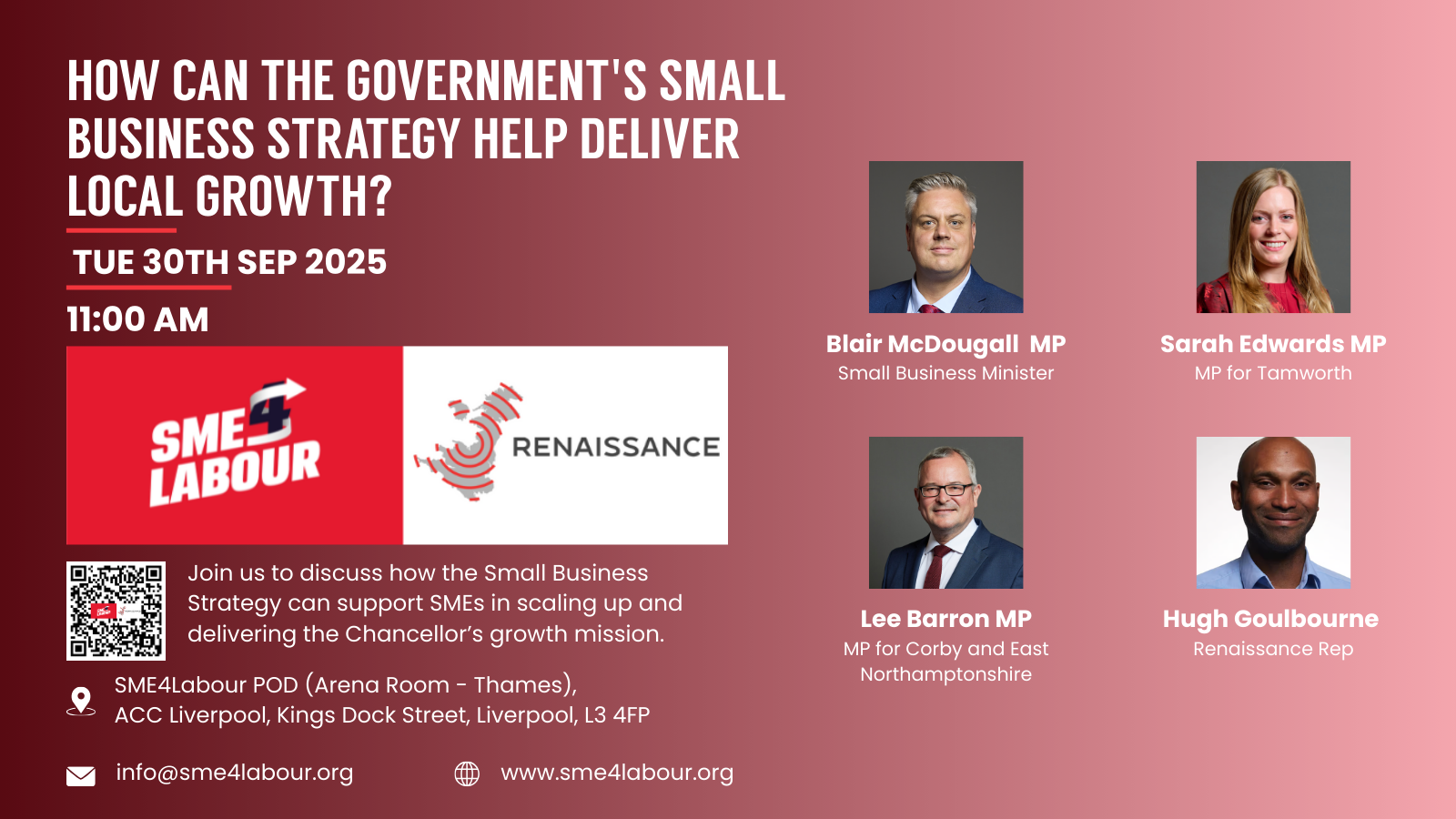
HOW CAN THE GOVERNMENT'S SMALL BUSINESS STRATEGY HELP DELIVER LOCAL GROWTH?

  • Date: September 30, 2025 at 11:00 - 12pm
  • Location: SME4Labour POD (Arena Room - Thames), ACC Liverpool Kings Dock Street, Liverpool, L3 4FP

The Labour Party Annual Conference 2025

SME4Labour and Renaissance fringe: HOW CAN THE GOVERNMENT'S SMALL BUSINESS STRATEGY HELP DELIVER LOCAL GROWTH?

Small-and-medium businesses stand ready to help deliver the Chancellor’s growth mission, but need more support to scale-up. A new report - Leveling the Playing Field - sets out what dozens of smaller businesses tell us they need from the government, and how the Small Business Strategy might unlock their potential. Join us to have your say.

Speakers:

  • Blair McDougall MP, Small Business Minister
  • Sarah Edwards MP, MP for Tamworth
  • Hugh Goulbourne , Renaissance Rep
  • Liz Hind

Chair: Joe Jervis, Director of Renaissance

This panel explored how the Government’s Small Business Strategy can translate into meaningful local economic growth, bringing together policymakers, practitioners, and small business advocates to bridge the gap between national ambition and everyday reality.

Opening the discussion, Chair Joe Jervis framed small and medium-sized enterprises (SMEs) as central to rebuilding local economies and reconnecting politics with communities. He emphasised that thriving small businesses underpin strong high streets, local identity, and economic resilience.

Small Business Minister Blair McDougall set out the scale of the challenge and opportunity, noting that SMEs account for 99.8% of UK businesses and a significant share of employment and turnover. He argued that the Government’s wider economic reforms—from infrastructure to labour market changes—must be felt tangibly through small businesses in local areas. High streets, he stressed, are where national policy becomes visible, and where public confidence in the economy is ultimately shaped. Tackling late payments, improving access to finance, and increasing support through institutions such as the British Business Bank were highlighted as immediate priorities.

Sarah Edwards MP reinforced the importance of listening directly to businesses on the ground. Drawing on roundtables and select committee work across the country, she highlighted the diversity of the SME sector and the difficulty of designing one-size-fits-all support. Many businesses, she noted, feel the current period is more challenging than even the pandemic, citing rising costs, lack of investment in local infrastructure, and fragmented support systems. However, she also pointed to renewed optimism following the introduction of a clear government strategy.

Hugh Goulbourne presented key findings from the Leveling the Playing Field report, which captures insights from SMEs nationwide. He identified three core priorities: improving access to finance, addressing regional disparities in industrial strategy, and establishing a dedicated “Business Investment and Growth” (BIG) unit within government. Such a unit, he argued, would provide a coordinated, systemic approach to tackling structural barriers and ensuring SMEs are treated as major economic actors rather than marginal ones.

Offering a lived perspective, Liz Hind delivered a powerful reflection on running a small business. She challenged traditional political narratives that separate “workers” from business owners, arguing that small business proprietors are themselves working people, deeply embedded in their communities. She highlighted practical pressures—from business rates and energy costs to administrative burdens—and called for government to reduce complexity so business owners can focus on serving customers and regenerating local high streets.

Across the discussion, several recurring themes emerged: the urgency of tackling late payments to unlock cash flow; the need for fairer access to finance amid both supply and demand constraints; the burden of energy costs and weak regulation in commercial supply markets; and the imbalance of power between small businesses and landlords or larger firms. Panellists also stressed the importance of coordination across government departments and better alignment between national policy and local delivery.

In closing, the panel converged on the need for practical, visible action. Priorities included enforcing faster payments, simplifying regulatory systems through a single business interface, addressing energy market dysfunction, and maintaining ongoing dialogue with SMEs. The discussion made clear that while the strategy provides a strong foundation, its success will depend on consistent, coordinated implementation that delivers real change on the ground.

Ultimately, the session underscored that empowering small businesses is not only an economic necessity but a political one—central to restoring confidence, revitalising communities, and delivering sustainable local growth across the UK.


DSC06200


Event summary

  • Date: September 30, 2025 at 11:00 - 12pm
  • Location: SME4Labour POD (Arena Room - Thames), ACC Liverpool Kings Dock Street, Liverpool, L3 4FP
  • Contact name: SME4Labour team
  • Contact email: [email protected]
  • Ticket price: Free
  • RSVP: RSVP using the form below.

Will you come?