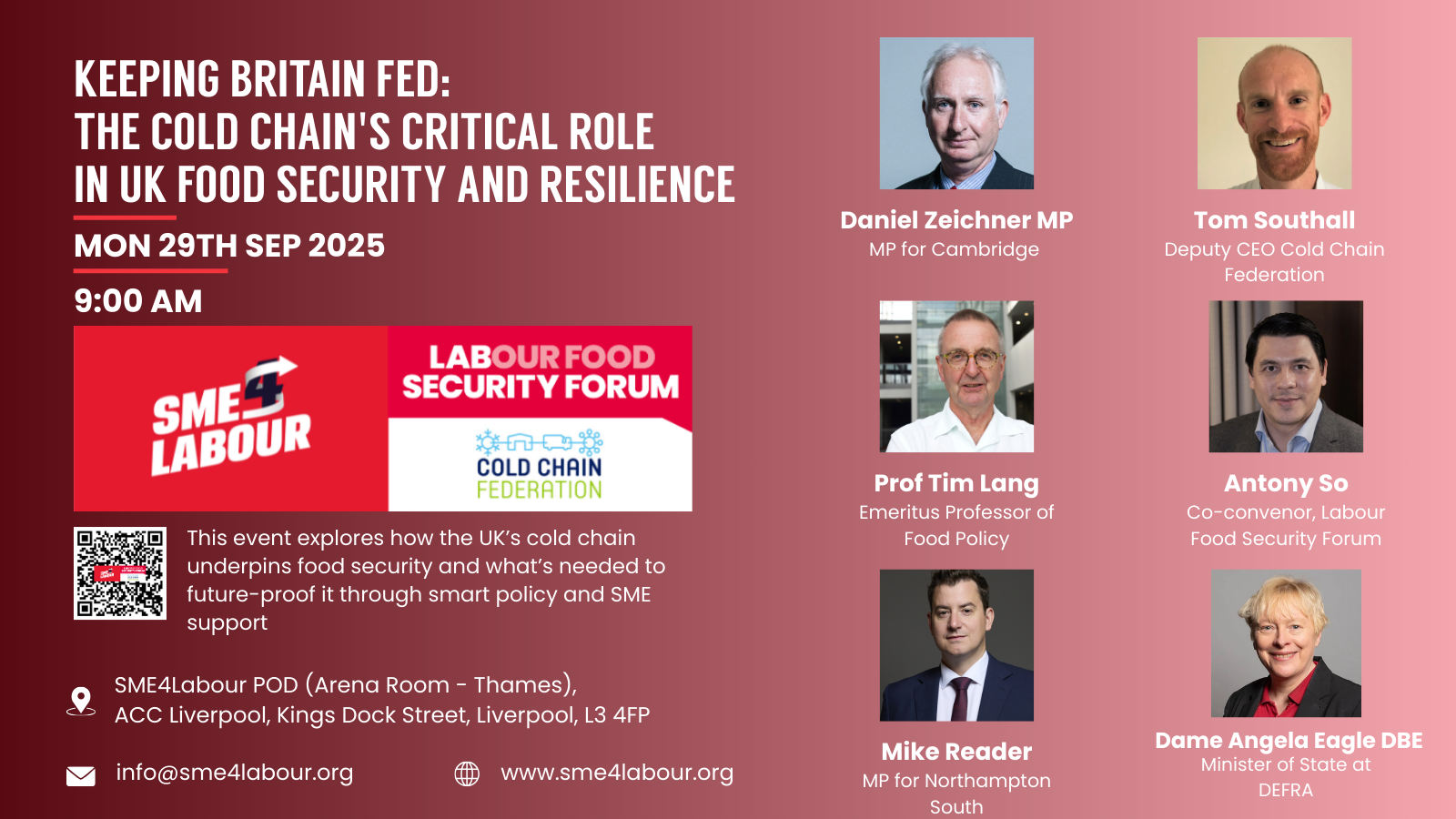
KEEPING BRITAIN FED: THE COLD CHAIN'S CRITICAL ROLE IN UK FOOD SECURITY AND RESILIENCE

  • Date: September 29, 2025 at 09:00 - 10am
  • Location: SME4Labour POD (Arena Room - Thames), ACC Liverpool Kings Dock Street, Liverpool, L3 4FP

The Labour Party Annual Conference 2025

SME4Labour Labour Food Security Forum and Cold Chain Federation fringe: KEEPING BRITAIN FED: THE COLD CHAIN'S CRITICAL ROLE IN UK FOOD SECURITY AND RESILIENCE

Speakers:

  • Daniel Zeichner MP, MP for Cambridge 
  • Tom Southall, Deputy CEO Cold Chain Federation
  • Professor Tim Lang, Emeritus Professor of Food Policy
  • Mike Reader MP, MP for Northampton South

Chair: Antony So, Co-convenor, Labour Food Security Forum

The panel discussion on “Keeping Britain Fed: The Cold Chain’s Critical Role in UK Food Security and Resilience” brought together policymakers, industry leaders and academics to examine the growing pressures on the UK’s food system and the urgent need for a more resilient, coordinated national strategy.

Opening the discussion, the Chair framed food security as an issue that has risen sharply up the political agenda, driven by what speakers described as the “three Cs” — COVID-19, conflict, and climate change — alongside ongoing trade disruptions and rising geopolitical tensions. Despite this, the panel questioned whether food security is truly being treated with the same urgency as energy or defence.

Professor Tim Lang set out a stark assessment of the UK’s current position, arguing that while there has been a positive shift in tone from government, action remains too slow and overly focused on supply rather than wider systemic issues such as public health, consumer behaviour and cultural attitudes to food. He highlighted the absence of a comprehensive legislative framework, calling for a dedicated Food Security and Resilience Act and warning that the UK’s longstanding reliance on global markets is becoming increasingly risky in a more competitive and unstable world.

A key theme throughout the discussion was the concept of resilience. Speakers emphasised that the UK’s highly efficient “just-in-time” food system, while effective under normal conditions, is inherently vulnerable to disruption. The need to transition towards a more robust “just-in-case” model — incorporating greater storage capacity, decentralisation and public preparedness — was widely debated.

From an industry perspective, Tom Southall highlighted the critical yet often overlooked role of the cold chain — the temperature-controlled supply network responsible for transporting and storing around half of the UK’s food. He stressed that this infrastructure underpins both food and pharmaceutical supply and has consistently proven its value during crises, from wartime storage to the COVID-19 pandemic. However, he warned that the sector faces mounting risks, including cyber threats, energy volatility and climate pressures, while lacking formal recognition as critical national infrastructure.

Parliamentary perspectives from Daniel Zeichner MP and Mike Reader MP underlined both progress and ongoing challenges within government. While there is increasing recognition of food as a systemic issue requiring cross-departmental coordination, speakers acknowledged that siloed working across departments remains a barrier. Encouragingly, examples were shared of food policy gaining greater prominence, including its integration into public health strategies and NHS planning.

The discussion also highlighted the importance of public engagement and behavioural change. Panellists argued that resilience cannot be achieved through infrastructure and policy alone; consumers must play an active role through informed choices, improved nutrition and greater awareness of food systems. Without this, there is a risk of panic behaviours in times of crisis, further destabilising supply chains.

Audience contributions broadened the conversation to include sustainable fishing, local food systems, public procurement and illegal imports, reinforcing the complexity of the food security challenge. The need for both national coordination and localised solutions emerged as a recurring theme.

The event concluded with a clear message: while the UK possesses world-leading expertise and infrastructure, including in the cold chain sector, the scale of emerging risks demands a more ambitious, coordinated and forward-looking approach. Strengthening food resilience will require not only government leadership and industry collaboration, but also a cultural shift in how food is valued, understood and managed across society.

DSC05917


Event summary

  • Date: September 29, 2025 at 09:00 - 10am
  • Location: SME4Labour POD (Arena Room - Thames), ACC Liverpool Kings Dock Street, Liverpool, L3 4FP
  • Contact name: SME4Labour team
  • Contact email: [email protected]
  • Ticket price: Free
  • RSVP: RSVP using the form below.

Will you come?